Dashboards
How to Run a Dashboard Review Without the Drama
Dashboards should help teams decide. Too often they make everyone perform concern.
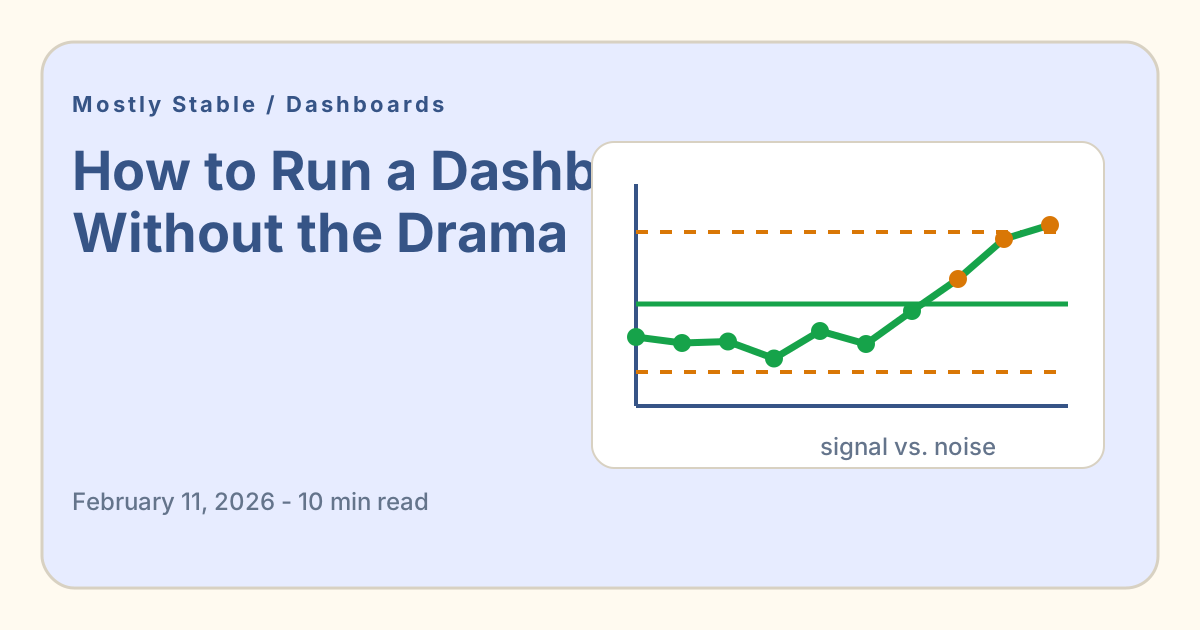
The most expensive dashboard is not the one with the highest software bill. It is the one that turns every meeting into a guessing session.
A dashboard review usually starts with good intent. Put the important metrics in one place. Review them regularly. Stay accountable. Then the ritual hardens. Red means explain. Green means move on. A spike means someone needs a story. A dip means someone needs an action item.
The problem is that many dashboards show movement without interpretation. They tell you what the metric did. They do not tell you whether the movement matters.
A calmer agenda
Try opening the review with three columns instead of one long list of numbers:
- Stable and capable: the metric is behaving predictably and meets the need.
- Stable but not good enough: the metric is predictable, but the system needs redesign.
- Signal detected: the metric shows evidence that something changed.
This framing keeps the team from mixing three different problems. A stable but poor process is not fixed by asking why Tuesday was bad. A real signal should not be buried under five normal wiggles.
Where process behavior charts fit
A process behavior chart sits underneath the dashboard and answers the question the dashboard skips: is this routine variation or a meaningful change? Once the chart gives you that answer, the meeting can move faster.
For routine variation, talk about system-level improvement. For signals, ask what changed. For capability gaps, talk about whether the current system can ever meet the target without being redesigned.
What to stop doing
Stop asking for a written explanation for every red cell. Stop celebrating one good week as a turnaround. Stop pretending a trend line knows the future. None of those habits create accountability. They create a queue of little stories that age badly.
The best dashboard review is not more dramatic. It is more disciplined.
The meeting script
A less dramatic dashboard review can still be direct. Open with signals first. "These are the metrics where the system appears to have changed." Then capability gaps. "These are stable processes that are not meeting the target." Then routine items. "These moved, but not in a way that suggests anything changed."
This order matters. It stops the room from spending twenty minutes on the loudest red cell before noticing the one metric that actually broke pattern.
What each category means
Signal detected means the team should investigate what changed. That investigation should be time-bound and specific. Look at releases, channel mix, staffing, incidents, seasonality, tracking changes, and external events around the signal.
Stable but not good enough means the system is predictably producing a result below the target. That is not an incident. It is an improvement agenda. The conversation should be about redesigning the process, funding changes, or resetting expectations.
Routine movement means the metric is doing what it usually does. That does not make it irrelevant. It means the latest point is not the reason to act.
How the dashboard itself should change
Put the latest value next to the interpretation. Do not make people infer it. "Inside expected range" is more helpful than a lonely red number. "Signal above upper limit" is more useful than an angry arrow. "Stable, below target" is the kind of phrase that changes behavior.
A good dashboard should also separate targets from behavior limits. Targets describe what you want. Limits describe what the current system produces. When those two are visually mixed, teams end up confusing aspiration with evidence.
Common pushback
Some leaders worry that calling something routine variation will make the team passive. In practice, the opposite usually happens. Once people stop defending every point, they have more energy to work on the system. Calm does not mean complacent. It means the team is no longer burning attention on the wrong layer of the problem.