Metric Reviews
Why Did This Metric Drop? A Better First Question
The fastest way to waste a morning is to explain a number that never needed an explanation.
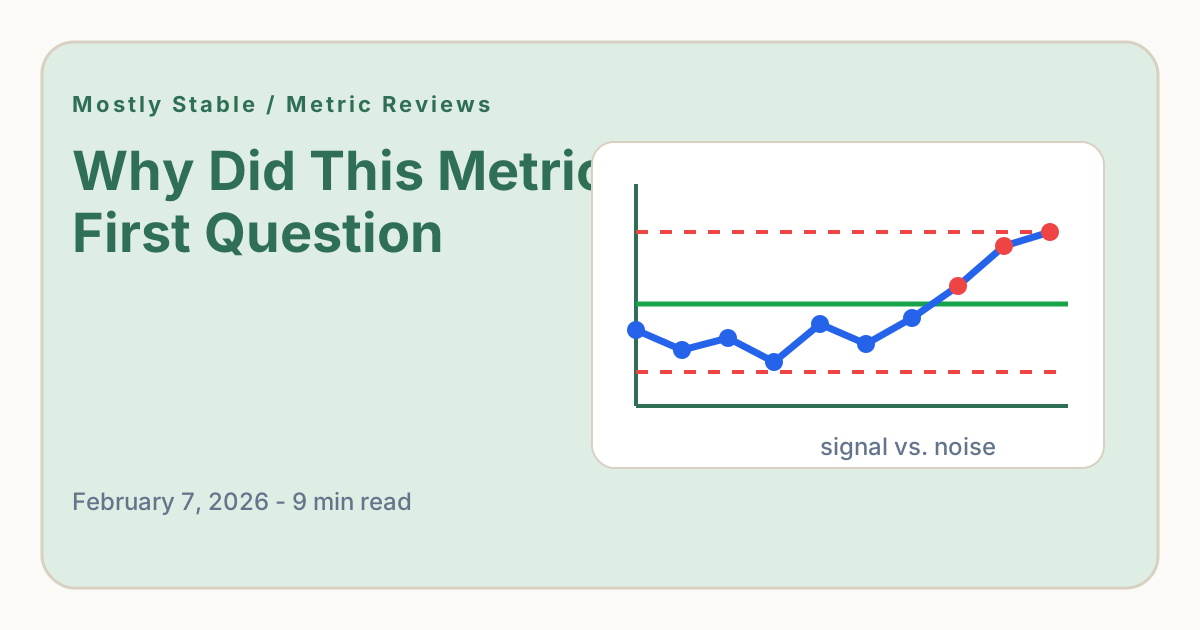
There is a familiar little panic that shows up in metric reviews. A line dips. Someone asks what happened. The analyst opens a few tabs. A product manager starts checking release notes. By lunch, three people have a theory and nobody is sure whether the metric actually changed.
The better first question is not, "Why did it drop?" It is, "Did the system behave differently from its usual range?" That question sounds quieter, but it saves a lot of time.
A drop is not always a signal
Every metric moves. Conversion rate moves. Support tickets move. Demo bookings move. Even a healthy system produces uneven data because customers, traffic, staff capacity, seasonality, and plain randomness are always moving around underneath the chart.
A process behavior chart gives that movement context. It uses your historical data to draw an expected range. Points inside the range are routine variation. Points outside the range, or patterns that break simple rules, are worth investigating because they suggest the system may have changed.
The meeting changes immediately
Without context, the room asks for explanations. With context, the room can decide whether explanation is even useful. If the drop is still inside the expected range, the useful conversation is about improving the system as a whole. If the drop breaks the range, the useful conversation is about what changed around that moment.
That distinction matters. One path creates theater. The other creates learning.
Use this before your next escalation
- Plot the metric in time order instead of comparing only two periods.
- Look for whether the latest point is inside the expected range.
- Investigate only when the chart shows a signal.
- If there is no signal, stop asking people to invent a cause for noise.
Metric reviews get better when teams stop treating every wobble as news. Sometimes the number dropped. Sometimes nothing happened.
A small example
Imagine a product team reviewing weekly activation: 42, 45, 41, 44, 43, 46, 40, 44, 42, 45. Then the latest week lands at 39. Someone can make that sound scary. "Activation is down 13 percent from last week" is technically true if last week was 45. It is also a poor way to understand the system.
If the normal range for the process is roughly 38 to 48, then 39 is not a mystery. It is part of the range the system already produces. The useful question is not why the week landed at 39. The useful question is whether a process that naturally produces weeks in the high 30s is good enough for the business.
The two mistakes teams make
The first mistake is treating a routine point as a special event. That creates false work: segment cuts, Slack threads, postmortems, and action items that do not connect to a real system change.
The second mistake is treating a real signal as just another wobble. This happens after teams have been burned by too many false alarms. They learn to shrug at the dashboard, and eventually they shrug at something that deserved attention.
Process behavior charts are useful because they protect against both mistakes. They make the default response less emotional and more consistent.
What to put in the follow-up note
When leadership asks about a metric drop, the best answer should include interpretation, not just facts. A useful note might say: "The metric is down versus last week, but it remains inside the expected range of this process. We do not see evidence of a special cause. The larger issue is that the current process range still includes weeks below our target."
That answer does three jobs. It acknowledges the drop, prevents a fake investigation, and redirects attention to the system-level improvement that would actually matter.
When you should still dig in
Charts are not a substitute for context. If the drop lines up with a known launch, a tracking change, a vendor outage, a legal deadline, or customer harm, investigate. The chart should guide the first read, not forbid judgment.
The habit to build is simple: do not start with a story. Start with behavior. Then decide whether a story is needed.