Revenue
Revenue Forecasting Gets Easier When You Respect Variation
A forecast built from a straight line can look precise while being badly informed.
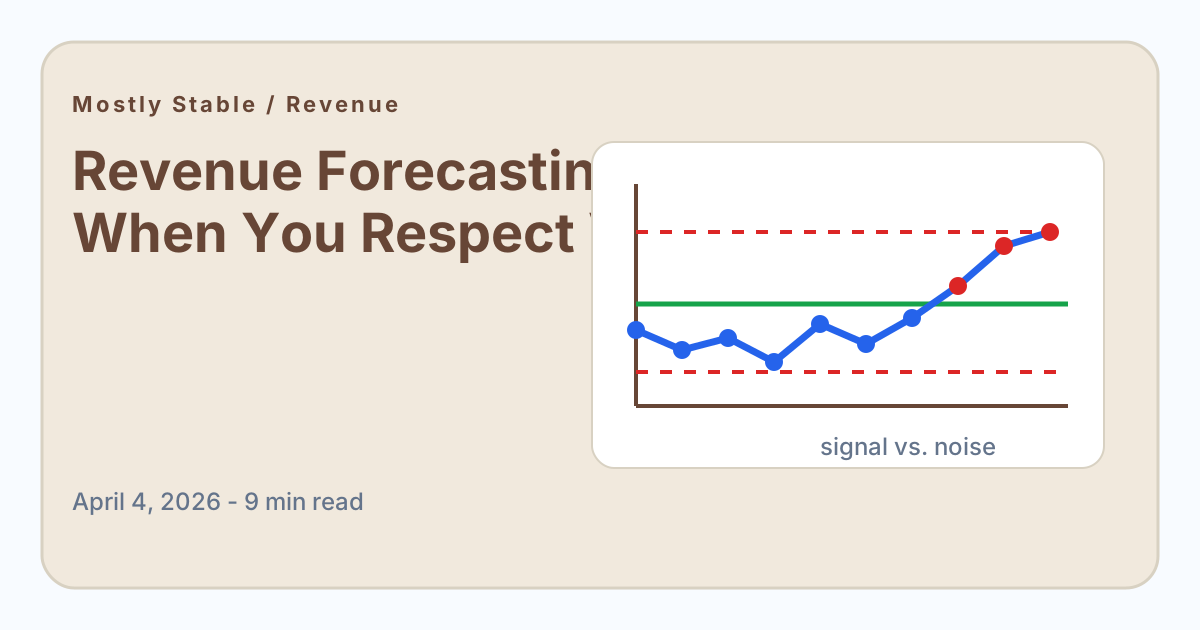
Revenue forecasting often turns messy behavior into a tidy slide. The line goes up. The confidence interval is implied by the speaker's tone. Everyone knows the real world will be rougher, but the chart looks clean enough to approve.
The problem is not forecasting. The problem is pretending variation is an inconvenience rather than part of the system.
Look at the natural range
Monthly revenue, pipeline creation, win rate, sales cycle length, and expansion bookings all vary. A process behavior chart shows the range those metrics have produced under the current system. That range is not a perfect forecast, but it is a much better starting point than a single optimistic line.
If pipeline creation is predictable but too low, the forecast problem is a capability problem. If pipeline suddenly breaks above the old range, the team should understand what changed before assuming the new level will hold.
Forecast conversations improve
Instead of asking, "Are we on track?" leaders can ask, "What does the current system predictably produce, and what would have to change to produce the target?" That question exposes the work behind the number.
It also prevents teams from explaining every miss as a one-off. Sometimes the forecast miss was not an exception. It was the predictable output of the system.
Use ranges, then name the levers
A useful revenue forecast should show current behavior, required behavior, and the specific system changes expected to close the gap. Anything else is just a more confident spreadsheet.
Single-number forecasts hide operational risk
A forecast that says "$420k next month" sounds decisive. But if the process normally produces a wide range, the single number can hide more than it reveals. Leaders need to know whether the forecast is built on a predictable system or on a hope that several lumpy inputs land at once.
Process behavior charts help by showing how much variation the revenue system already contains.
Forecast the inputs, not just the outcome
Revenue is downstream of pipeline creation, win rate, deal size, sales cycle, expansion, churn, and collections. If revenue misses, the cause may have appeared earlier in one of those inputs. Charting the inputs helps the team spot whether the system shifted before the final number disappoints.
For example, if qualified pipeline has been stable below the required range for six weeks, the revenue miss is not a surprise. It is a delayed consequence.
Use three forecast bands
A practical revenue review can show three bands: current process range, target range, and committed interventions. The current range says what happens if nothing meaningful changes. The target range says what the business needs. The interventions say how the team expects to close the gap.
This makes the forecast a management tool rather than a ritual of optimism.
When a positive signal appears
A positive signal deserves the same rigor as a negative one. If pipeline jumps above the old range, find out why. Was it a campaign, a channel, a one-off event, a sales behavior change, or a tracking artifact? If the team understands the cause, it may be able to repeat it. If not, the spike may become another story that fades next month.