Marketing
Leads Were Down Last Month. Now What?
Sometimes the honest answer is not a campaign story. It is that lead volume is lumpy.
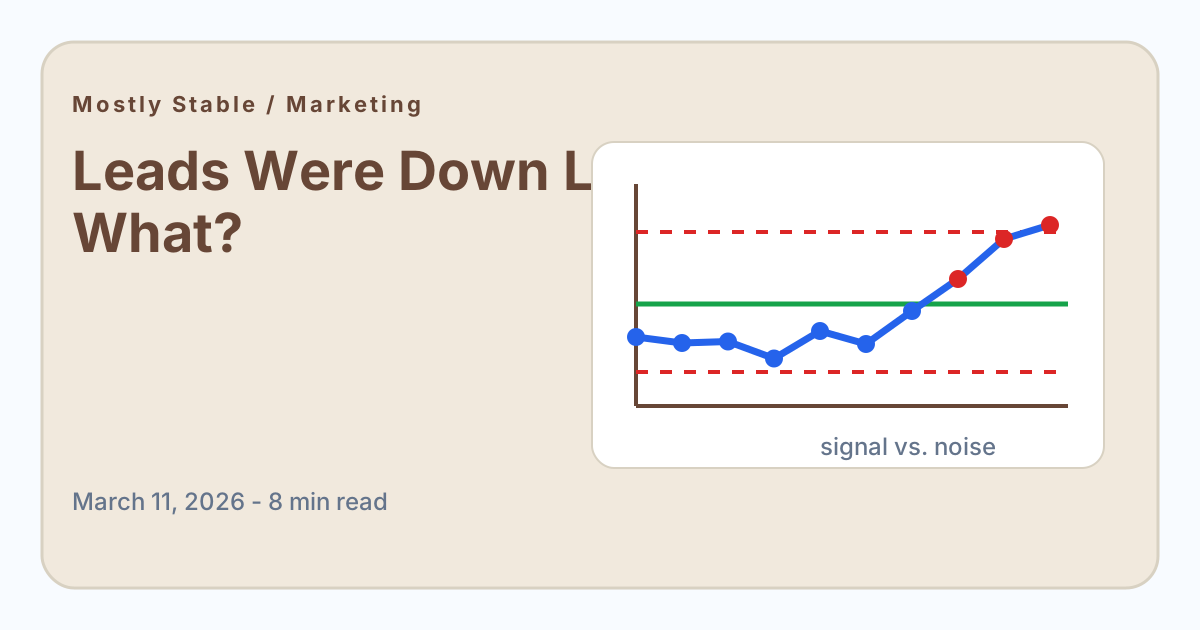
"Leads were down last month" is a sentence that can hijack a marketing meeting. It feels specific. It feels urgent. It feels like there must be a reason.
There might be. But monthly lead volume is often lumpy. Paid spend shifts. Organic traffic lands unevenly. Enterprise prospects go quiet near budget cycles. One webinar pulls forward demand. Another misses. A calendar month is a convenient reporting bucket, not proof that the market changed.
Put the month in context
Instead of comparing last month to the month before, plot lead volume across time. Add process behavior limits. Then ask whether the latest month is outside the normal range.
If it is not, the team can stop inventing a tidy explanation. The useful question becomes, "How do we improve the lead generation system?" That might mean better offers, stronger distribution, cleaner segmentation, or faster follow-up.
When the chart does show a signal
If the month breaks the expected range, now the investigation has teeth. Look for changes around that period: budget cuts, tracking failures, sales territory changes, channel mix, event timing, search updates, competitor moves, or a broken form.
The point is not to avoid accountability. It is to aim accountability at real change.
How to answer leadership
A strong answer sounds like this: "Leads are down, but still inside the range this system has produced for the last year. We do not see evidence of a special cause. The bigger issue is that our current system is not predictably producing the volume we need."
That is a grown-up answer. It will not fit in a red cell, but it will help the business.
The marketing calendar creates false drama
Months are uneven containers. They have different numbers of weekdays, different holidays, different campaign schedules, and different buying rhythms. A month with fewer workdays can look worse even when the underlying demand process is unchanged.
That does not mean monthly reporting is useless. It means monthly comparisons should be interpreted carefully.
Look for the system behind lead volume
Lead volume is produced by a system: audience, offers, distribution, website conversion, sales follow-up, brand demand, paid budget, search visibility, events, and referrals. If the chart shows routine variation, the team should improve that system rather than explain the latest month.
If the chart shows a signal, the investigation should be narrow. Did one channel break? Did tracking change? Did an event shift into another month? Did sales reject more leads because qualification changed? Did paid spend pause? Did a form stop firing?
Do not stop at lead count
A lead-volume drop may be fine if lead quality improved. A lead-volume spike may be bad if it came from low-intent traffic. Chart qualified leads, conversion to opportunity, cost per qualified lead, and sales-accepted rate alongside raw volume.
The goal is not to defend marketing. The goal is to avoid optimizing the easiest number while missing the business outcome.
A better monthly note
A strong marketing note separates facts, behavior, and action: "Lead volume was 11 percent lower than March. It remains inside the expected range. Qualified-lead rate improved, and opportunity creation is stable. No special-cause investigation recommended; the priority remains improving demo-page conversion."