Engineering
DORA Metrics Without the Scorekeeping Trap
The point of delivery metrics is learning, not ranking teams on a slide.
DORA metrics are useful because they point at real parts of software delivery: deployment frequency, lead time, change failure rate, and time to restore service. They get much less useful when they become scorecards without context.
Engineering systems are noisy. A team can deploy less often for two weeks because of a holiday, a risky migration, a dependency freeze, or just the shape of the work. Lead time can jump because three unusually large items landed together. Not every movement deserves a process sermon.
Plot delivery as behavior
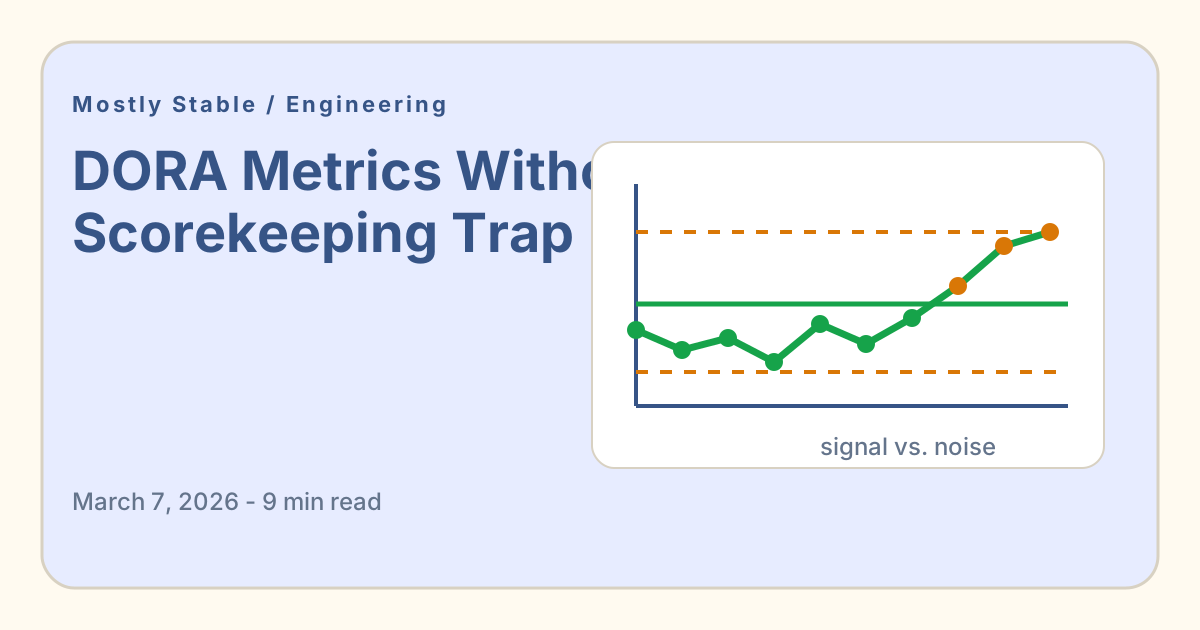
A process behavior chart lets the team see whether a delivery metric is moving inside its normal range or showing a real shift. That matters because DORA metrics should help teams test improvement ideas, not punish ordinary variation.
For example, if deployment frequency stays inside the expected range after a tooling change, the change may not have shifted the system. If lead time shows a sustained run below the old average after a team changes its review policy, that is a stronger sign the work changed.
Use the chart in retros
A good retrospective question is not, "Why were we slower this sprint?" It is, "Did our delivery system behave differently?" If yes, investigate what changed. If no, talk about system improvements that could shift the average or reduce variation.
This keeps delivery metrics from becoming another way to pressure teams. The chart makes the learning agenda visible.
One rule for leaders
Never compare teams without understanding their systems. A platform team, product squad, and infrastructure group may all have different natural ranges. Process behavior charts are most useful when they help a team understand its own system over time.
Delivery metrics are outputs of a system
Deployment frequency is shaped by architecture, release confidence, test speed, review norms, team boundaries, product risk, incident load, and deployment tooling. Lead time is shaped by batch size, queues, WIP, dependencies, and review delay. These are system properties, not just team effort.
That is why raw DORA numbers can become unfair when used as scorekeeping. A metric without process context invites shallow conclusions.
Useful engineering questions
Process behavior charts help engineering leaders ask better questions:
- Did the new CI work reduce lead time, or are we seeing normal variation?
- Did the release train policy change deployment behavior?
- Did onboarding three engineers create a temporary delivery signal?
- Is change failure rate stable but too high for the risk profile?
- Are incidents random-looking, or did a new class of failure appear?
Those questions lead to engineering work. "Why were deployments down last week?" often leads to a status performance.
Use team-local baselines
A team working on a mobile app release process should not be compared casually to a backend platform team with continuous deployment. Their systems are different. Start by helping each team understand its own behavior over time. Cross-team learning can come later, once context is visible.
Make improvement claims harder to fake
If a team says a new review policy improved lead time, plot the metric before and after the change. A sustained shift is stronger evidence than a nice anecdote. If the chart does not show a shift, that does not mean the policy was useless. It means it did not move that metric enough to show up yet.