Analytics
How Data Teams Can Reduce 'Please Explain' Requests
The best self-serve analytics feature might be a chart that says, quietly, this is normal.
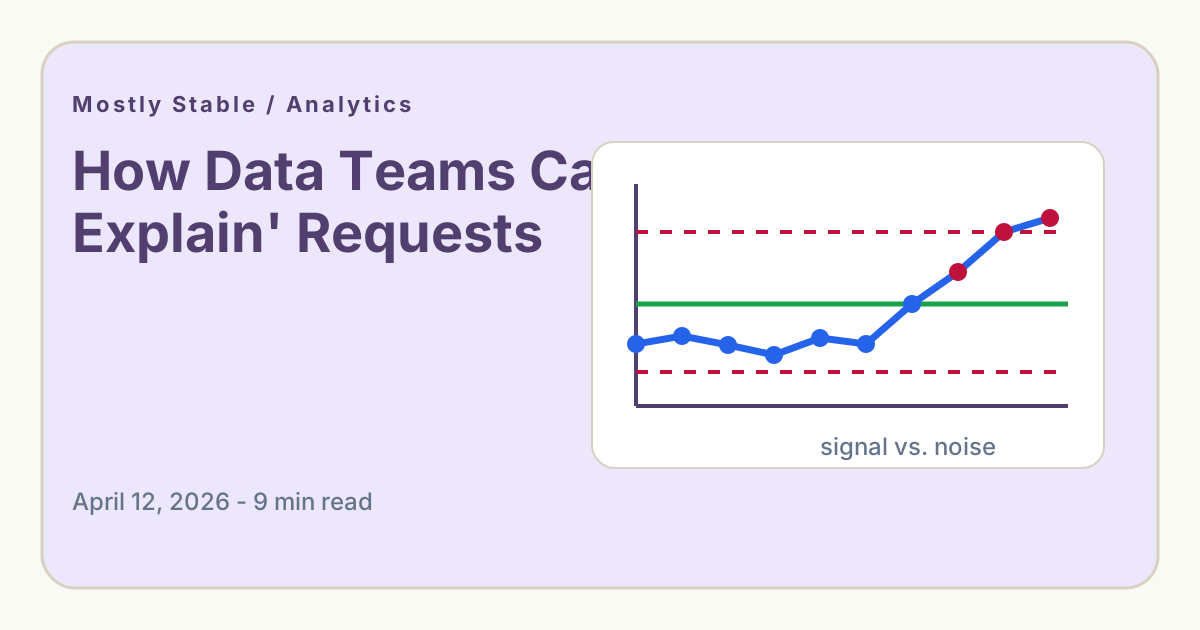
Many data teams are buried under small investigations. Why was traffic down? Why did activation move? Why did the Midwest region miss? Why is the dashboard red?
Some of those questions are important. Many are just normal variation with a calendar label attached.
The hidden cost
A "quick check" can consume an hour. The analyst pulls segments, checks instrumentation, scans recent releases, and writes a careful answer. The answer often boils down to: nothing obvious changed.
That is honest, but it is also expensive when repeated across dozens of metrics.
Give stakeholders an interpretation layer
Process behavior charts reduce low-value requests because they make the first triage visible. If the metric is moving inside its expected range, the stakeholder can see that a special explanation is unlikely. If the chart shows a signal, the analyst has a better starting point.
This does not eliminate analysis. It protects analysis for moments when it can produce learning.
How to roll it out
- Add process behavior charts to the metrics that generate the most ad hoc questions.
- Write a short interpretation note under each chart.
- Teach teams the difference between a target miss and a behavior signal.
- Track how many requests become unnecessary after the change.
Data teams do not need to become gatekeepers. They need better defaults. A chart that prevents a pointless question is a quiet win.
Why the requests keep coming
Stakeholders ask for explanations because dashboards rarely tell them how to interpret movement. If the only visible facts are "up," "down," and "red," asking the data team is rational. The problem is not the stakeholder. The problem is the missing interpretation layer.
Process behavior charts can move the first layer of interpretation into the dashboard itself.
Build a request deflection pattern
For each high-request metric, add three pieces of context: the process behavior chart, a plain-language interpretation, and a suggested next action. For example: "This week's trial starts are inside expected range. No special-cause investigation recommended. Current improvement work remains focused on paid-search quality."
That note answers the first question before it becomes a ticket.
When analysts should still get involved
A signal is a good reason for deeper analysis. So is a high-stakes metric, a suspected tracking issue, a strategic decision, or a repeated capability gap. The goal is not to block requests. It is to reserve analyst time for work where analysis can change a decision.
Measure whether it worked
Track the number of ad hoc explanation requests before and after adding behavior charts. Also track response quality. The win is not only fewer tickets. The win is better tickets: more specific, more contextual, and more likely to lead to action.
Teach one phrase
"Is this signal or noise?" is a simple phrase, but it changes how stakeholders approach the data team. It turns a vague request into a shared diagnostic step.