Growth
Your Conversion Rate Dipped. Is It Real or Just Noise?
A 4 percent conversion dip can be a clue. It can also be Tuesday.
Conversion rate is one of those metrics that invites overconfidence. It is tidy, important, and easy to compare. That makes it dangerous.
Say signup conversion falls from 3.4 percent to 3.1 percent. The number feels small until someone annualizes it. Then it feels expensive. People start looking for a cause: new landing page copy, paid traffic quality, pricing objections, slow page load, competitor launch, tracking bug.
Maybe one of those is true. Maybe none of them are.
Do not compare two dots
A before-and-after comparison is usually too thin. Conversion rates naturally move because traffic sources, buyer intent, day-of-week mix, device mix, and sample size move. Two dots do not tell you whether the process changed.
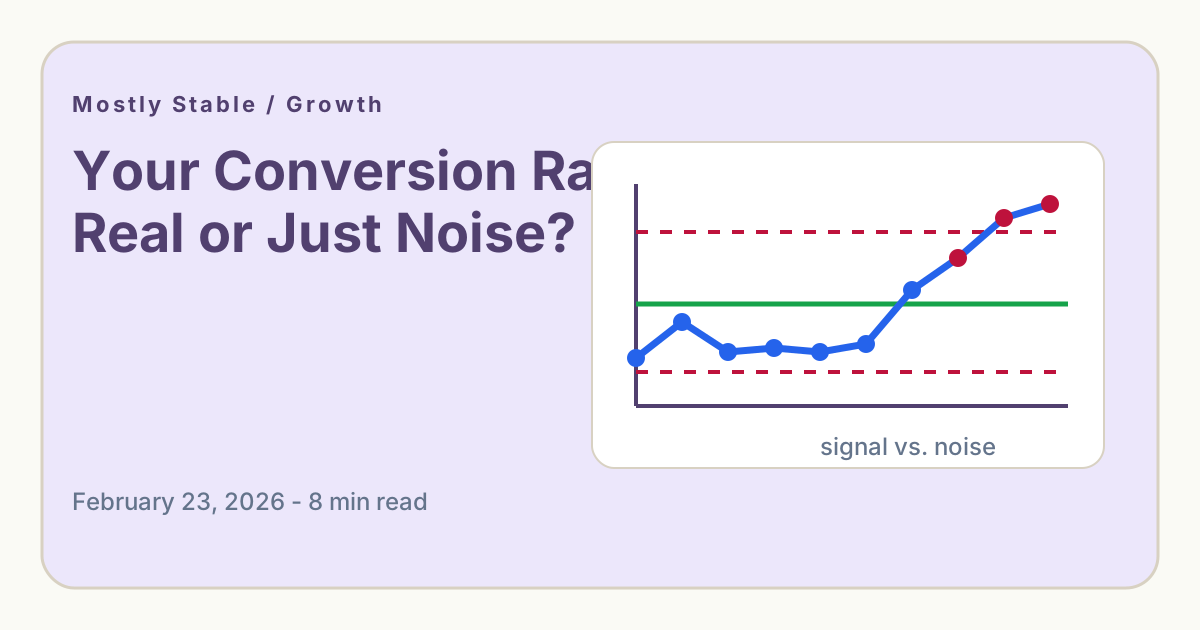
Put the metric in time order. Then use a process behavior chart to calculate the normal range. If the latest dip is inside the limits, it is probably routine variation. If it breaks the limits or starts a signal pattern, you have a stronger reason to investigate.
What this changes for growth teams
Growth teams are paid to learn quickly, but chasing noise is not learning. It is motion. Process behavior charts give experiments and campaigns a cleaner read because they make the baseline visible before the team declares a win or loss.
They also make it easier to talk about uncertainty. You can say, "Conversion is still within normal behavior," or, "This is the first signal that the funnel may have shifted." Both sentences are more useful than, "It is down, so something must be wrong."
One habit to add
Before opening a root cause doc, ask the chart whether the dip is unusual. You will still investigate real problems. You will just stop feeding normal variation into the investigation machine.
Conversion rate has hidden moving parts
A conversion rate looks like one number, but it is a ratio built from many shifting inputs. Paid traffic can grow while organic traffic softens. Mobile share can rise. A single partner campaign can bring high-intent visitors for three days. A pricing page can load slower in one geography. The headline number hides all of that.
This is why teams should avoid treating conversion movement as a simple verdict. The first job is to decide whether the movement is unusual. The second job, only if needed, is to find the cause.
A practical triage flow
- Chart the overall conversion rate over time.
- Check whether the latest movement is inside normal process behavior.
- If it is a signal, split by the few segments most likely to explain it: channel, device, geo, landing page, plan, or customer type.
- Check instrumentation before debating product or messaging causes.
- Write down the leading hypothesis and what data would disprove it.
The order is important. Segmenting every ordinary dip trains the team to confuse exploration with progress.
How this helps with experiments
A process behavior view can keep growth teams from calling a test too early. If conversion after a landing page change is still inside the old behavior limits, the new page may not have changed the system. If the chart shows a run above the old average, the team has a stronger reason to keep studying the change.
This does not replace an A/B test when you have enough traffic and a clean test setup. It helps with the many real-world situations where teams ship changes, observe the business metric, and need a disciplined read.
The sentence to teach the team
"Down" is a direction, not a diagnosis. Once that sentence becomes normal, conversion discussions get much sharper.